

close
Choose Your Site
Global
Social Media
Views: 0 Author: Site Editor Publish Time: 2026-07-19 Origin: Site


Mitigating low-frequency structural vibration and airborne noise in commercial, industrial, and marine environments remains a persistent engineering challenge. Facility managers and acoustic engineers constantly seek materials that dampen sound effectively without adding excessive weight or bulk to the infrastructure. Traditional acoustic materials, such as fiberglass or open-cell foams, often fall short in these demanding settings. They frequently fail in high-moisture environments, lack necessary structural durability, require complex secondary vapor barriers, or cause severe skin irritation during the installation process.
To address these limitations, engineers specify elastomeric composites. This advanced material bridges the gap between acoustic dampening, thermal resistance, and environmental durability. By combining the flexibility of rubber with the resilience of PVC, it provides a unified barrier against noise, heat transfer, and moisture ingress. Understanding the technical properties of this material helps you specify the right insulation for demanding technical applications.
Structural Advantage: The closed-cell architecture (typically 0.1–0.5mm cell diameter) of NBR PVC provides superior vibration damping and sound transmission loss compared to standard open-cell alternatives.
Multi-Functional Performance: Beyond acoustics, it acts as a highly effective thermal barrier and moisture retardant, eliminating the need for multi-layered insulation systems in HVAC and plumbing.
Compliance & Safety: High-grade formulations function as a fireproof rubber foam board, meeting strict building codes for flame spread and smoke development.
Fabrication & Physical Resilience: Offers excellent dimensional stability, a scratch-resistant hard skin surface, and skin-friendly handling, allowing for safe installation without protective equipment.
The performance of NBR PVC Foam Board stems directly from its hybrid polymer composition. Nitrile Butadiene Rubber (NBR) provides the core flexibility, inherent oil resistance, softness, and high elasticity required for vibration absorption. Polyvinyl Chloride (PVC) is integrated into the matrix to contribute high tensile strength, exceptional chemical resistance, weatherability, and long-term dimensional stability. This specific blend creates a viscoelastic material capable of stretching and conforming to irregular surfaces while maintaining structural integrity under mechanical stress.
When you handle this material on a job site, you immediately notice the difference compared to standard plastics. It stretches around pipe elbows and irregular duct joints without tearing. The PVC component ensures that once it is glued down, it does not shrink back and expose seams over time. We rely on this dimensional stability to prevent thermal bridging and acoustic leaks in long duct runs.
The internal physics of a closed cell rubber foam board dictate its acoustic and thermal capabilities. During the manufacturing process, gas is trapped within the polymer matrix, creating millions of isolated microscopic pockets, typically ranging from 0.1 to 0.5mm in diameter. Because these cells do not interconnect, they completely block moisture ingress and airflow.
Acoustically, these isolated gas pockets act as individual micro-shock absorbers. When sound waves or mechanical vibrations strike the material, the cellular structure compresses and expands, effectively dissipating the acoustic energy. This is vastly different from open-cell foams that allow air and sound to pass through their interconnected pores.
Material density plays a major role in acoustic performance. Specific density ranges determine the material's capacity to block different acoustic frequencies. Higher density formulations excel at impeding low-frequency structural rumbles, while optimized softer variants handle higher frequency airborne noise.
The high elongation capacity of the elastomeric blend allows the board to stretch around complex geometries, such as curved ductwork or irregular machinery housings, without tearing or losing its insulative thickness. In the field, this means fewer cuts, fewer seams, and a faster installation process.
Many engineered variants feature a specialized PVC skin finish. This dense, hard surface layer is integrated directly during the extrusion or molding process. The skin significantly improves scratch resistance and mechanical durability, protecting the softer cellular core from physical impact.
This smooth surface alters the surface-energy characteristics, making it easier to clean and highly resistant to the accumulation of dust, grease, and industrial particulates. In cleanroom environments or food processing facilities, this wipe-down capability is a mandatory specification.
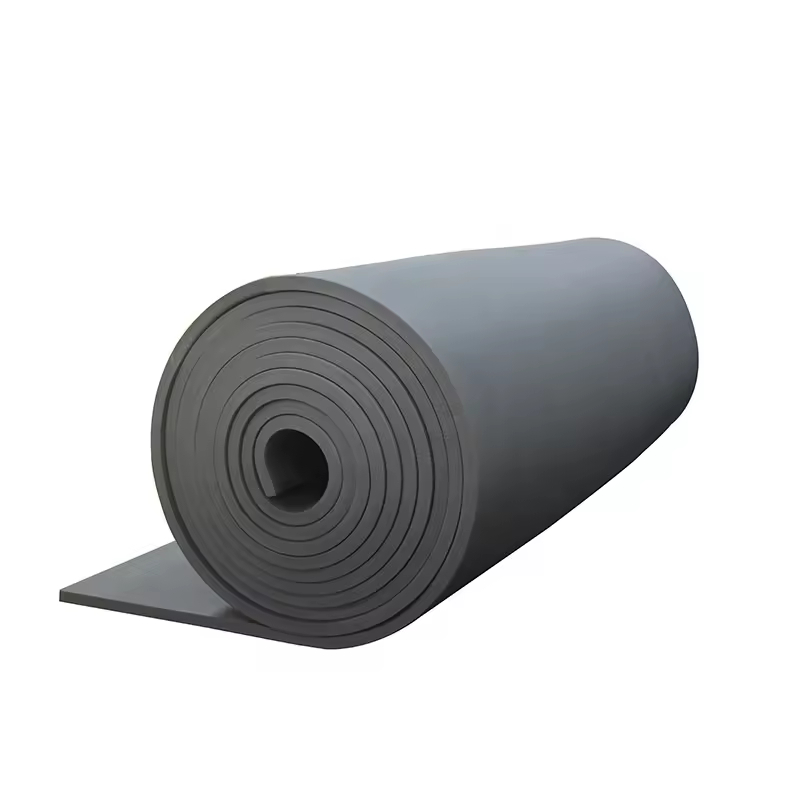
In architectural and industrial acoustics, preventing sound from traveling between spaces is paramount. The high density and mass of the NBR PVC composite physically impede the transmission of airborne sound waves. When installed within wall cavities, partition assemblies, or ceiling plenums, the dense elastomeric barrier reflects and absorbs a significant portion of the acoustic energy.
We frequently use this material to wrap noisy waste pipes in commercial high-rises. The mass of the foam blocks the airborne noise of rushing water, while the elastomeric nature decouples the pipe from the drywall framing.
Mechanical equipment, engines, and high-velocity airflow generate intense structure-borne vibrations that travel through metal substrates. The viscoelastic properties of the foam board excel at damping these vibrations. The material converts the mechanical vibration energy into trace amounts of thermal energy through internal friction within the polymer chains.
Applying this insulation directly to metal panels prevents resonance, deadening the ringing effect commonly associated with sheet metal enclosures. You will see this applied heavily inside generator housings and large air handling units.
Evaluating acoustic materials requires understanding Sound Transmission Class (STC) and Noise Reduction Coefficient (NRC) ratings. Closed-cell foams inherently possess high STC ratings, meaning they are highly effective at blocking sound from passing through a barrier.
While flat closed-cell materials have lower NRC ratings compared to open-cell foams, engineered profiles solve this issue. Convoluted or egg-crate Nitrile foam profiles significantly increase the surface area, improving surface absorption and effectively reducing internal echoes and reverberations within enclosed spaces.
When utilizing foam boards for sound reduction between adjoining rooms, practical architectural realities must be addressed. Flanking paths—where sound travels around the insulation through floors, ceilings, or ductwork—can compromise performance.
To achieve optimal room-to-room sound reduction, the insulation must be installed continuously, with all seams properly sealed. The inherent density of the elastomeric board ensures that, when installed correctly, it provides a formidable barrier against both voice frequencies and low-frequency mechanical noise.
Acoustic performance is only one facet of this material. The closed-cell structure results in exceptionally low thermal conductivity. This makes it highly effective at preventing heat transfer. In mechanical systems, it plays a major role in preventing condensation on cold water lines, refrigeration piping, and chilled air ducts.
By keeping the surface temperature of the insulation above the ambient dew point, it eliminates sweating and the subsequent risk of water damage. This dual-purpose nature saves contractors from installing separate acoustic and thermal layers.
Industrial and commercial applications demand strict adherence to fire safety protocols. Premium formulations incorporate advanced flame-retardant additives, classifying the material as a fireproof rubber foam board. Specifiers must verify compliance with standard testing frameworks.
We always check for ASTM E84, UL 94, or Class 0/Class 1 ratings on the technical data sheets. These tests evaluate flame spread and smoke density, ensuring the material will not rapidly propagate fire or release excessive toxic smoke during an emergency.
The inherent vapor barrier properties of the closed-cell structure provide absolute resistance to moisture penetration. This prevents the formation of mold, mildew, and bacterial growth within the insulation layer. The polymer matrix resists degradation from common industrial chemicals, oils, and HVAC lubricants.
In high-traffic installations or exposed mechanical rooms, the scratch-resistant PVC skin protects the insulation core from accidental impacts and physical wear. You do not need to apply a secondary protective jacket in most indoor mechanical rooms.
To fully understand the value of elastomeric composites, we benchmark them against traditional insulation options used in the field.
Feature | NBR PVC Foam Board | Open-Cell Polyurethane (PU) | Fiberglass / Mineral Wool |
|---|---|---|---|
Cell Structure | Closed-cell | Open-cell | Fibrous |
Moisture Resistance | Excellent (Built-in vapor barrier) | Poor (Absorbs water) | Poor (Requires secondary barrier) |
Acoustic Function | High transmission loss & damping | Good absorption, poor blocking | Good absorption, poor damping |
Health & Safety | Skin-friendly, no particulate shedding | Safe, but prone to mold if wet | Skin irritation, respiratory hazards |
Durability | High (Scratch-resistant skin) | Low (Easily torn) | Low (Compresses easily) |
Open-cell PU foam is widely used for basic sound absorption, but it suffers from severe moisture vulnerability and low physical toughness. It acts like a sponge in humid environments, absorbing water which destroys its acoustic properties and promotes mold growth.
The waterproof, highly durable, and dimensionally stable nature of elastomeric closed-cell boards ensures consistent performance regardless of ambient humidity or physical contact. We never specify open-cell foam in chilled water plants or marine environments for this exact reason.
Fibrous materials like fiberglass and mineral wool present significant health and safety concerns. They shed microscopic particulates that cause skin irritation and pose respiratory hazards during installation and maintenance. They require complex, easily punctured secondary vapor barriers to prevent moisture ingress.
Elastomeric foams are clean, non-irritating, and skin-friendly. They completely eliminate the need for secondary vapor barriers, streamlining installation and improving long-term safety for maintenance crews working around the equipment.
While PE and EVA foams are common closed-cell alternatives, they lack the specific viscoelastic properties required for optimal acoustic damping. NBR PVC offers superior shock absorption, higher elongation, and better thermal stability at extreme temperatures.
It achieves this without sacrificing the softness and flexibility needed to wrap tight radii on pipes or conform to complex machinery housings. PE foam tends to be rigid and snaps when forced around sharp 90-degree duct corners.
Air handling units and extensive duct networks require materials that handle multiple challenges simultaneously. Using elastomeric sheets for HVAC duct insulation effectively silences high-velocity airflow vibration and sheet metal rattling.
Concurrently, it prevents thermal loss from conditioned air and completely stops surface condensation in unconditioned spaces, ensuring system efficiency and longevity. We apply this directly to the exterior of rectangular ductwork using full-coverage contact adhesive.
Heavy machinery, compressors, and power generators produce intense low-frequency noise and severe vibrations. Lining the interior of metal enclosures with dense elastomeric foam dampens heavy engine noise and prevents the metal casing from amplifying the sound.
The material's inherent resistance to oil, fuel, and chemical exposure ensures it will not degrade when subjected to the harsh conditions inside an engine compartment. We often use a convoluted profile here to maximize sound absorption inside the metal box.
Transportation sectors demand strict weight-to-performance ratios. Heavy acoustic mass loaded vinyl is often too heavy for marine or rail applications. Elastomeric foam boards provide excellent structural damping and cabin noise reduction at a fraction of the weight.
Specialized formulations meet the strict fire safety and smoke toxicity regulations required for passenger transport vehicles. Shipbuilders use this extensively to isolate engine room noise from passenger cabins.
In commercial construction, controlling noise transfer between sensitive spaces is critical. Elastomeric boards are utilized in floating floor assemblies to decouple the finished floor from the subfloor, reducing impact noise.
They are also used within wall cavities and as wraps for noisy internal plumbing lines to drastically reduce structural sound transmission. Wrapping PVC waste lines with a 1-inch elastomeric foam completely deadens the sound of flushing water in luxury apartments.
Selecting the correct material profile is critical for project success. Engineers must specify the appropriate thickness, density, and surface profile based on the target decibel reduction and the specific frequency range of the noise source.
Low-frequency vibrations require higher density and thicker sheets, while internal room echo reduction benefits from convoluted surface profiles that maximize sound absorption area. Always consult the manufacturer's acoustic test data before finalizing the specification.
Fabricating and installing elastomeric foam is straightforward but requires precision. The material can be easily cut, routed, and shaped using standard utility knives or CNC equipment. For optimal acoustic and thermal performance, seamless installation is mandatory.
Measure and cut the foam board to size, allowing a slight oversize for compression fitting.
Apply a compatible high-strength contact adhesive to both the substrate and the foam backing.
Wait for the adhesive to become tacky to the touch before mating the surfaces.
Apply firm, even pressure across the entire board to ensure 100% adhesion without air pockets.
Seal all butt joints and seams using specialized elastomeric seam-sealing tapes or thermal welding techniques.
While highly durable, standard elastomeric foams have environmental limitations, particularly regarding prolonged direct UV exposure outdoors. UV radiation can eventually degrade the polymer chains, causing surface cracking.
To mitigate this, outdoor installations require protective metal cladding, application of UV-resistant elastomeric coatings, or the specification of specialized outdoor-grade formulations designed specifically to withstand prolonged sunlight and weather exposure.
Request technical data sheets and safety data sheets from suppliers to verify exact density and fire ratings for your specific application.
Obtain physical samples to test flexibility, skin hardness, and adhesive compatibility on your actual job site substrates.
Consult with acoustic engineers to determine the exact thickness and profile required to mitigate your specific noise frequencies.
Review local building codes to ensure the selected formulation meets all necessary flame spread and smoke development regulations.
A: It excels at soundproofing by blocking transmission due to its high density and closed-cell structure, which impedes sound waves and dampens structural vibration. For sound absorption to reduce internal room echoes, engineered convoluted profiles are used to increase surface area and trap airborne sound.
A: Yes, but with precautions. Standard formulations are susceptible to UV degradation over time. For outdoor use, the material must be protected with metal jacketing, UV-resistant coatings, or you must specify a specialized outdoor-resistant formulation designed to withstand prolonged sunlight.
A: Compliance is achieved through specific flame-retardant additives in the polymer matrix. The material must pass standardized tests like ASTM E84, UL 94, or achieve Class 0/Class 1 ratings, proving it restricts flame spread and limits toxic smoke development during a fire.
A: It performs exceptionally well. Unlike fiberglass, it does not shed irritating particulates, making installation safer. Its closed-cell structure acts as a built-in vapor barrier, preventing condensation and mold, while simultaneously dampening duct vibration and preventing thermal loss.
A: Yes. Advanced installation techniques allow certain PVC-rich formulations to be thermally welded or heat-sealed. This creates airtight, watertight, and completely seamless joints, which is critical for cleanroom environments or high-pressure industrial duct applications.
A: When installed correctly indoors away from UV exposure, it can last 15 to 20 years or more. Its long-term dimensional stability ensures it resists settling, compacting, or degrading, maintaining its acoustic and thermal properties throughout its lifecycle.
A: The material is easily cut using sharp utility knives or CNC routing tools for complex shapes. Installation requires applying specific elastomeric or high-strength contact adhesives to both the substrate and the foam, ensuring a secure, gap-free bond.


