

close
Choose Your Site
Global
Social Media
Views: 0 Author: Site Editor Publish Time: 2026-07-23 Origin: Site


In high-stakes commercial, industrial, and specialized residential environments, failing to control condensation and radiant heat simultaneously leads to rapid system degradation, mold proliferation, and severe energy loss. Specifiers frequently misapply standard rigid foams or un-faced elastomeric sheets in areas requiring both extreme moisture resistance and radiant heat reflection. Incorrect material selection or improper facing orientation compromises the vapor barrier, invalidates fire ratings, and drives up lifecycle maintenance costs. Evaluating the precise installation environments, orientation rules, and structural limitations of Aluminum Foil Faced Rubber Foam Board is necessary for ensuring long-term thermal performance and regulatory compliance. Field engineers must understand exactly where and how to deploy this material to maximize its dual-action protective properties across complex mechanical systems.
Optimal Use Cases: Best deployed in environments requiring dual-action protection: condensation control (via closed-cell rubber) and radiant heat reflection (via the foil facer), such as HVAC ductwork, chilled water systems, and specific building envelope zones.
Strict Orientation Rules: The aluminum foil facer must generally face the heat source, the primary fire risk zone, or the airspace where radiant reflection is required.
Material Superiority: Compared to standard rigid boards, NBR PVC foam board offers superior flexibility for curved surfaces and mechanical vibration dampening, while the foil adds mechanical strength, grid-aligned cutting guides, and UV protection.
Implementation Criticality: The system's integrity relies entirely on proper seam sealing; unsealed joints negate the foil's vapor barrier properties and lead to localized condensation failure.
Defining the baseline requirements for insulation in high-moisture, high-temperature-differential environments is the first step toward system reliability. Mechanical systems operating below ambient temperatures face constant vapor drive. Moisture in the air naturally seeks out cold surfaces. When insulation fails to stop this vapor, condensation forms on the pipe or duct surface. This leads to corrosion under insulation and eventual system failure. We see this constantly in poorly specified chilled water lines where standard fiberglass was used instead of a closed-cell elastomeric solution.
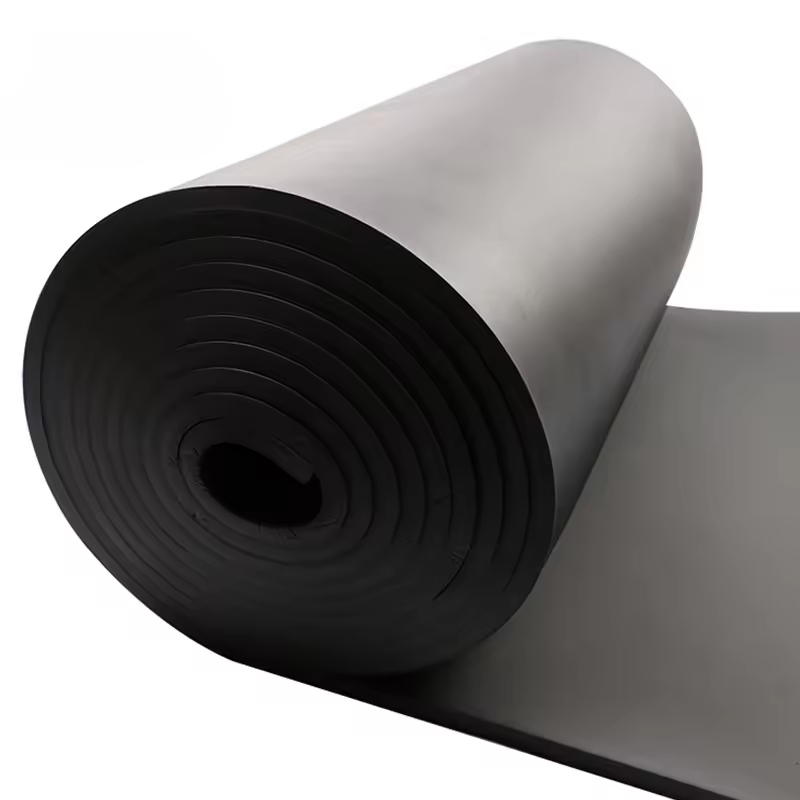
The core of this solution relies on closed-cell NBR PVC foam board. This elastomeric blend provides inherent resistance to water vapor transmission. The closed-cell structure traps inert gas within millions of tiny bubbles. This prevents moisture from migrating through the material thickness. It maintains a stable thermal conductivity over its lifespan. The rubber matrix also offers exceptional flexibility. This allows it to conform to complex mechanical shapes without cracking or breaking. Installers can wrap large-diameter pipes and irregular duct transitions with minimal fabrication time.
Adding an aluminum foil layer transforms the elastomeric core into a high-performance composite. The foil provides high radiant heat reflectivity. It boasts excellent emissivity ratings, bouncing radiant energy away from the insulated system. Furthermore, the foil acts as a zero-permeance vapor retarder. It completely blocks moisture ingress at the surface level. The metallic layer also enhances physical durability. It protects the softer rubber core from punctures, abrasions, and minor mechanical impacts during maintenance. This is particularly useful in tight mechanical rooms where technicians frequently move heavy equipment.
The combination of elastomeric flexibility and rigid foil facing translates directly to reduced installation time. When wrapping large ducts or curved tanks, rigid board alternatives require precise beveling and multiple segmented cuts. A foil faced rubber foam board easily bends around these geometries. Installers can cover large surface areas quickly. The foil provides enough rigidity to keep the material flat on straight runs, while the rubber core conforms to structural irregularities. This reduces labor hours and minimizes the number of seams that require sealing.
Selecting the right environment for this material maximizes its performance characteristics. It excels in areas where traditional insulation types fail due to moisture, vibration, or complex geometry. Field experience shows that misapplication often stems from a misunderstanding of vapor drive dynamics.
Ductwork routing through unconditioned spaces requires robust protection. Exterior and interior duct applications present different challenges. As a moisture resistant duct insulation, this material prevents sweating in attics, crawlspaces, and mechanical rooms. The foil reflects radiant heat from hot roofs in summer. The closed-cell rubber prevents warm, humid air from reaching the cold metal of air conditioning ducts. This eliminates condensation and protects surrounding building materials from water damage. We frequently specify this for rooftop package units where both solar heat gain and internal condensation are major concerns.
Sub-ambient temperature operations demand absolute condensation control. Applying insulation on large-diameter pipes and tanks reveals the limitations of rigid materials. Rigid insulation cannot easily conform to large radii without extensive fabrication. Flexible rubber boards wrap smoothly around these structures. They prevent surface condensation and eliminate thermal bridging. The continuous vapor barrier provided by the foil ensures the chilled water system operates efficiently without ice formation or water dripping. In industrial food processing plants, this prevents contamination from overhead pipe drip.
Architectural spaces benefit from the dual-action properties of this insulation. You can install it between rafters or floor joists. This creates a continuous vapor barrier and prevents moisture build-up within the structural cavity. When mounting over structural sheathing, you can use horizontal or vertical configurations. The foil reflects heat away from living spaces during summer. The rubber core prevents winter heat loss. This makes it highly viable for specialized envelope zones requiring stringent vapor control, such as indoor pool enclosures or high-humidity manufacturing floors.
Workshops, solar sheds, and unconditioned agricultural outbuildings face extreme temperature swings. Applying this material in these structures manages interior climates effectively. The foil facer acts as a radiant barrier. It sheds the external solar heat load. Meanwhile, the rubber core manages interior moisture levels. This prevents condensation from dripping onto tools, equipment, or stored goods during rapid temperature drops. Installation is straightforward, often requiring only mechanical fasteners with sealed washers and high-quality contact adhesive at the perimeter.
Insulating tight, custom-built mechanical boxes or structural cavities presents unique thermal challenges. You must manage heat retention while preventing external condensation on internal surfaces. The flexibility of the rubber allows it to fit snugly into irregular spaces. The foil facing protects the insulation from radiant heat generated by enclosed equipment. This creates a stable internal microclimate for sensitive machinery. We use this extensively in custom pump enclosures where space is limited and thermal control is mandatory.
Heavy machinery generates significant noise and structural vibration. Leveraging rubber insulation materials in generator rooms, elevator shafts, and equipment enclosures solves two problems at once. The dense elastomeric core absorbs sound waves and dampens mechanical vibrations. Simultaneously, the foil facing provides thermal control and fire resistance. This dual functionality reduces the need for separate acoustic and thermal treatments. It streamlines the installation process and reduces overall material weight on the structural frame.
Improper orientation of the foil facer completely negates its benefits. You must understand the physics of radiant heat, fire safety, and vapor drive to install the material correctly. A reversed board is a wasted board.
Technical guidelines dictate orienting the foil toward the radiant heat source. For a radiant barrier to function effectively, it requires an adjacent airspace. You must maintain at least a 3/4 inch gap between the foil and the next solid surface. Without this airspace, the foil conducts heat rather than reflecting it. If you install the board tight against a hot roof deck, the radiant reflection property is lost. Always design the assembly with furring strips or standoffs to guarantee this critical air gap.
Building codes strictly regulate fire-rated facers. The aluminum foil side typically carries the required fire rating. Therefore, it must be installed facing the fire risk side of the assembly. If you are insulating a mechanical room, the foil must face the interior of the room. This meets strict ASTM or regional fire safety guidelines by providing a flame-resistant surface where a fire is most likely to originate. Inspectors will fail an installation if the un-faced rubber is exposed in a return air plenum.
Orientation also depends on climate zones and the direction of vapor drive. The foil acts as the primary vapor barrier. It must be installed on the warm side of the insulation assembly. In cold climates, this usually means facing the heated interior. In hot, humid climates, it faces the exterior. This prevents moisture from entering the insulation and condensing within the wall or duct assembly. Getting this wrong leads to interstitial condensation and rapid mold growth within the building envelope.
Many manufacturers print grid lines on the foil facer. These lines serve as precise cutting and alignment guides. Using these grids helps installers maintain squareness during fabrication. It reduces joint gaps and ensures a tighter fit. Cutting along the grid lines does not compromise the thermal or radiant reflectivity parameters of the foil. It simply speeds up the fabrication process on the job site, allowing for rapid deployment over large flat surfaces like rectangular ductwork.
Selecting the right insulation requires comparing material properties, costs, and long-term performance metrics. Field conditions dictate which material will survive the intended lifespan of the mechanical system.
Performance Metric | Foil-Faced Rubber Foam | Un-faced NBR PVC | Foil-Faced Polyiso |
|---|---|---|---|
Radiant Heat Reflection | High (Requires airspace) | None | High (Requires airspace) |
Flexibility & Conformity | Excellent | Excellent | Poor (Rigid) |
Vapor Permeability | Zero (Impermeable) | Very Low | Low (Foil is zero, core can absorb if punctured) |
Vibration Dampening | High | High | Low |
Installation Speed on Curves | Fast | Fast | Slow (Requires segmenting) |
A cost-to-benefit analysis often dictates the choice between faced and un-faced rubber. The added expense of the foil facer is justified in specific scenarios. If the installation faces outdoor UV exposure, high radiant heat, or requires physical impact resistance, the foil is necessary. It is also preferred for aesthetic requirements in exposed mechanical rooms. Standard un-faced rubber suffices in dark, enclosed spaces where radiant heat and physical damage are not concerns. We often mix both on a single project, using faced material in the mechanical room and un-faced in the concealed chases.
Evaluating flexibility reveals a stark contrast. Polyiso and fiberglass boards are rigid. They struggle to conform to tight, irregular spaces or curved ducts. Rubber foam bends easily. R-value stability over time also favors rubber. Closed-cell rubber maintains its thermal resistance. Polyiso can experience off-gassing, losing R-value as aging occurs. Furthermore, fiberglass carries severe moisture absorption risks if the vapor barrier is breached. Impermeable rubber prevents water logging entirely, ensuring the system weight does not increase over time due to trapped condensation.
Even the best materials fail if installed incorrectly. Managing implementation risks ensures the insulation system performs as designed over its intended lifespan. Field execution is just as important as material specification.
Proper layout planning prevents premature failure. The critical rule is using maximum board lengths. This minimizes the total number of linear joints. Fewer joints mean fewer opportunities for vapor leaks. You must arrange seams strategically. Offset them to reduce exposure to structural movement and known moisture pathways. Staggering joints adds mechanical stability to the overall insulation jacket. When wrapping large ducts, always place the longitudinal seam on the bottom or side, never on the top where dust and moisture settle.
Vapor leaks at board edges represent the most critical risk. If moist air penetrates a seam, it will condense on the cold surface below. Mitigation requires high-adhesion, reinforced aluminum foil tape. You must apply this tape with proper pressure. Using a plastic squeegee ensures the adhesive wets out completely onto the foil facer. Hand pressure alone is insufficient to create a permanent, vapor-tight seal. We mandate a minimum 3-inch wide tape for all primary seams to ensure adequate overlap.
Securing the boards requires evaluating trade-offs. Contact adhesives provide full coverage, creating a strong, continuous bond. However, they require specific temperature conditions to cure. Mechanical fasteners are faster but present a significant risk. They penetrate the foil facer, creating holes in the vapor barrier. If you must use fasteners, you must properly seal every penetration with foil tape or mastic to prevent thermal bridging and moisture ingress. Stick pins should be used sparingly and only when adhesive alone cannot support the material weight.
You must evaluate the limits of the aluminum facer. While durable, it is not indestructible. Harsh weather, physical impact in high-traffic maintenance zones, and chemical exposure in industrial plants can degrade the foil. In extreme environments, you may need to apply a secondary weatherproof jacketing over the foil-faced rubber. This protects the primary insulation system from mechanical damage and corrosive airborne chemicals. Aluminum or stainless steel cladding is often required for exterior rooftop piping runs.
Consult with a mechanical engineer to calculate the exact thickness required for your specific dew point parameters based on local climate data.
Request material samples to test adhesive compatibility with your specific metal substrates before full-scale procurement.
Audit your installation layout to ensure maximum board lengths are utilized to minimize seam vulnerabilities across the entire duct run.
Verify that your chosen foil tape matches the perm rating and adhesion requirements of the primary foil facer.
Establish a quality control checkpoint to inspect all squeegeed seams before the system is commissioned and brought down to operating temperature.
A: Yes. The foil side must generally face the heat source to reflect radiant energy. It must also face the primary fire risk zone to comply with fire ratings. To function as a radiant barrier, it requires an adjacent airspace.
A: Installer grid lines assist in precise sizing and cutting. They help reduce joint gaps and maintain squareness during installation. This ensures a tighter fit around complex mechanical geometries without compromising performance.
A: Yes, the aluminum foil provides excellent UV resistance, protecting the rubber core from sun degradation. However, in extreme environments with heavy physical wear or severe weather, additional weatherproof jacketing is recommended.
A: For complex or curved ductwork, yes. It offers superior flexibility, conforms easily to large radii, provides mechanical vibration dampening, and delivers absolute moisture resistance without the risk of off-gassing associated with polyiso.
A: Yes, if you are using it as a radiant barrier. The physics of radiant barriers require at least a 3/4 inch airspace to reflect heat. Without this space, the foil will conduct heat directly into the adjacent material.
A: You must use matching high-adhesion reinforced aluminum foil tape. Ensure the surface is clean and dry. Apply the tape using a hard plastic squeegee to apply firm pressure, ensuring a complete, vapor-tight seal.
A: Yes. The aluminum foil facer typically improves the overall fire performance, often helping the assembly achieve Class A fire ratings. It significantly lowers the flame spread and smoke developed indices compared to un-faced rubber.


